Finance Minister announced the abolition of the angel tax, aiming to strengthen the startup ecosystem and support innovation in India.
What is Angel Investment?
An angel investor is an individual who provides financial backing to early-stage startups or entrepreneurs, typically in exchange for equity in the company.
Angel investors are typically high-net-worth individuals who invest their own personal funds, rather than investing on behalf of a firm or institution.
Features of Angel Investing: Early-stage funding, equity investment, high-risk, high-reward, active involvement,personal investment,f lexible terms and shorter investment horizon.
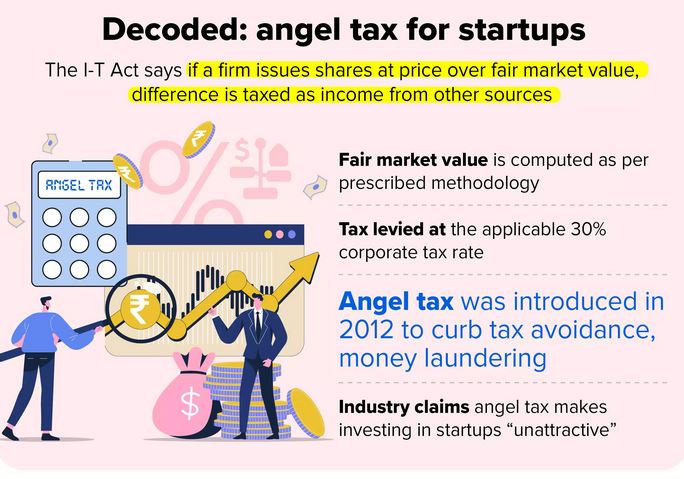
What is Angel Tax?
Referred to as Angel Tax, this rule is described in Section 56(2)(vii)(b) of the Income Tax Act, 1961.
Essentially it’s a tax on capital receipts, unique to India in the global context.
This clause was inserted by the Finance Actin 2012 to prevent laundering of black money, round-tripping via investments with a large premium into unlisted companies.
The tax covers investment in any private business entity, but only in 2016 was it applied to startups.
Why was angel tax introduced?
The complicated nature of VC fundraisingwith offshore entities, multiple limited partners and blind pools is contentious.
There has been some element of money laundering or round-tripping under guise.
Details of its levy
The Angel Tax is being levied on startups at 9% on net investments in excess of the fair market value.
For angel investors, the amount of investment that exceeds the fair market value can be claimed for a 100% tax exemption.
However, the investor must have a net worth of ₹2 crores or an income of more than ₹25 Lakh in the past 3 fiscal years.
Key Issues with Angel Tax
Share Valuation: The tax impacted the valuation of shares, causing complications for startups in raising funds.
Discounted Cash Flow (DCF) Method: Issues arose with the treatment of estimated figures in the DCF method, leading to disputes.
Scrutiny of Funding Sources: The scrutiny of funding sources and investor credibility added another layer of complexity for startups.
Retrospective Application: The retrospective application of the tax and its effect on the conversion of convertible instruments into equity were also significant points of dispute.
Significance for the Startup Community
Startups has long advocated for a more supportive and less restrictive environment for fundraising.
With this change, the government aims to create a more favourable atmosphere for innovation and investment in India.
PYQ:
[2014] What does venture capital mean?
(a) A short-term capital provided to industries.
(b) A long-term start-up capital provided to new entrepreneurs.
(c) Funds provided to industries at times of incurring losses.
(d) Funds provided for replacement and renovation of industries.
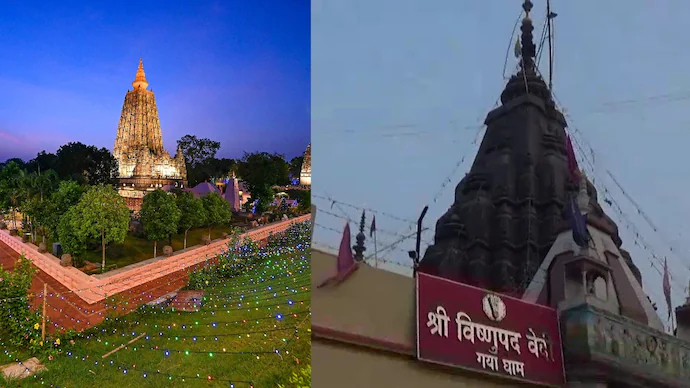
Finance Minister announced during her Union Budget speech that corridor projects will be built for the Vishnupad Temple at Gaya and the Mahabodhi Temple at Bodh Gaya in Bihar.
These will be modelled on the Kashi Vishwanath Temple Corridor, to transform them into world-class pilgrim and tourist destinations.
About the Vishnupad Temple at Gaya
Details
Dedicated to
Lord Vishnu
Significance
Contains a 40 cm long footprint of Lord Vishnu; considered sacred in Hinduism; attracts pilgrims for “Pind Daan” rituals.
Historical Importance
Believed to be over 1000 years old; associated with various legends and historical references in Hindu texts.
Architecture
Built in Shikhara style;
Features intricate carvings and silver-plated flagposts;
Constructed of grey granite blocks.
Built by
Queen Ahilyabai Holkar of Indore in 1787.
Festivals and Rituals
Major site for “Pind Daan” rituals during Pitru Paksha;
Attracts thousands of pilgrims during this period.
Mythology
The footprint is believed to be where Lord Vishnu placed his foot to subdue the demon Gayasur.
Associated River
Located on the banks of the Phalgu River, considered sacred for ritual offerings.
Access and Visitation
Accessible year-round; major pilgrimage site with facilities for devotees.
Recent Developments
Ongoing efforts for preservation and restoration; improved infrastructure for pilgrims.
About the Mahabodhi Temple Complex:
Details
Location
Bodh Gaya, Bihar;
Significance
Marks the location where Buddha attained enlightenment
UNESCO Status
World Heritage Site since 2002
Historical Importance
One of the four holy sites related to Buddha’s life (Enlightenment).
Other holy sites: Lumbini (Birth) in Nepal, Sarnath (First Sermon) in Uttar Pradesh, Kushinagar (Death) in Uttar Pradesh
Original Construction
Built by Mauryan Emperor Ashoka around 260 BCE
Reconstruction
Reconstructed in brick during the late Gupta period (5th or 6th centuries)
Archaeological Finds
Indicates site of veneration since the Mauryan period.
Vajrasana (Diamond Throne): Located within the temple, dated to the third century BCE
Main Temple Structure
Dates from the 6th century CE, incorporates parts from 2nd or 3rd century CE
Architectural Features
Two large shikhara towers, the largest over 55 meters high
Influenced Jain, Hindu, and Buddhist architecture globally
Materials
Made mostly of brick covered with stucco
Bodhi Tree
Direct descendant of the original tree under which Buddha attained enlightenment
Traditional Accounts
Describes 7 weeks Buddha spent meditating after enlightenment at various spots within the complex
Decline and Revival
Declined after Huna invasions and early Islamic invasions.
Revived under the Pala Empire (8th-12th century).
Declined again after 12th century CE invasions by Turk armies.
The government plans to roll out U-WIN, an online vaccine management portal for childhood vaccination, across the country.
Similar to CoWIN used during the Covid-19 pandemic, U-WIN aims to digitize and individualize immunization records from birth.
What is U-WIN?
Children up to 6 yearsold and pregnant mothers are registered on U-WIN using government IDs like Aadhaar and their mobile phone numbers.
Records of all 25 shotsgiven to a child and the two given to pregnant mothers are added to the platform.
It’s Working:
The platform generates a color-coded vaccination certificate.
The digital vaccine certificate can be downloaded by parents using their registered mobile numbers, eliminating the need for a physical vaccination booklet.
After each shot is administered and recorded, the date is added to the card, which also shows the due date for the next set of vaccines.
U-WIN sends SMS reminders to parents before their children are due for the next dose.
U-WIN helps locate thenearest vaccination center and book available slots.
Significance:
1) For providing Immunization:
U-WIN’s reminders to parents are likely to improve compliance with vaccination schedules.
The platform ensures portability, allowing children to receive their doses anywhere in the country, particularly benefiting children of migrant workers.
Registration at birth may help reduce the number of “zero dose” children, those who have not received any vaccinations.
2) For Health Workers:
The platform can automatically generate a due list of children in specific areas for health workers.
These data points can be utilized by other government programs and eventually connected through the ABHA (Ayushman Bharat Health Account) ID.
Integration with Existing Systems
U-WIN will link to the government’s existing eVIN platform for inventory management.
eVIN tracks all vaccine vials, from central stores to each vaccination site, monitoring doses used, wasted, and returned, and tracks real-time temperature and humidity using sensors.
U-WIN runs on the same principles and digital infrastructure as CoWIN, making adoption straightforward.
Most vaccinators are familiar with similar platforms, ensuring a smooth transition.
Zero Dose Children
In India, the coverage of the first dose of diphtheria, pertussis, and tetanus (DPT)-containing vaccine is taken as the proxy for zero dose children.
Data from WHO and UNICEF showed that while 93% of children received their first vaccine dose, there were still 1.6 million zero dose children in India in 2023.
The data also showed that 1.6 million children missed their first measles-containing vaccine in 2023, up from 1.1 million the previous year.
This is concerning as in 2022, five states — Bihar, Gujarat, Haryana, Jharkhand, and Maharashtra — reported a rise in the incidence of measles.
PYQ:
[2016] ‘Mission Indradhanush’ launched by the Government of India pertains to:
(a) Immunization of children and pregnant women
(b) Construction of smart cities across the country
(c) India’s own search for the Earth-like planets in outer space
Rogue waves, unusually large waves compared to those before and after them, pose significant threats to ships, coastal and offshore infrastructure, and human lives.
Until now, there has been no method to forecast rogue waves.
What Are Rogue Waves?
Rogue waves are unusually large and unpredictable waves that are much larger than the surrounding waves.
They are often defined as waves that are at least twice the height of the surrounding waves.
Formation:
Rogue waves can form when swells from distant weather systems converge to create a single, amplified wave.
They may also form when ocean currents compress swells, creating strong, high waves.
Features:
Traditionally, rogue waves have been difficult to predict due to their sudden appearance and rare occurrence.
The lack of real-time forecasting methods has made it challenging to mitigate their impact effectively.
What is Sea State?
In oceanography, sea state refers to the condition of the surface of a large body of water at a specific location and time.
The World Meteorological Organization (WMO) sea state code characterizes sea state based on wave height on a scale of 0 (no waves) to 9 (waves over 14 meters).
Characteristics:
Unlike typical waves, rogue waves can appear suddenly and without warning.
They defy the average sea state, making them exceptionally dangerous.
Threats Posed by Rogue Waves:
(1) Shipping
For Ships and Vessels: Rogue waves pose a significant threat to ships and other vessels at sea. Their unexpected and massive size can lead to capsizing or severe damage.
For Offshore Infrastructure: Oil rigs, wind turbines, and other offshore structures can be heavily damaged or destroyed by rogue waves.
(2) Coastal Threats
Coastal Erosion: The sheer force of rogue waves can lead to accelerated coastal erosion, affecting beaches and shorelines.
Flooding: Rogue waves can cause sudden and severe coastal flooding, posing risks to coastal communities and ecosystems.
(3) Human Safety
Loss of Life: Rogue waves have been responsible for numerous fatalities. Between 2011 and 2018, rogue waves killed at least 386 people.
Property Damage: The impact of rogue waves on ships, coastal areas, and offshore structures can result in significant financial losses.
Advancements in Forecasting
University of Maryland mathematicians Thomas Breunung and Balakumar Balachandran have developed an artificial intelligence program capable of forecasting rogue waves.
The AI program was trained using billions of data points collected by a network of 172 ocean buoys.
The researchers analyzed 20-minute long samples recorded by ocean buoys.
PYQ:
[2017] At one of the places in India, if you stand on the seashore and watch the sea, you will find that the sea water recedes from the shore line a few kilometres and comes back to the shore, twice a day, and you can actually walk on the sea floor when the water recedes. This unique phenomenon is seen at:
The Supreme Court has agreed to hear a plea seeking to redefine the constitutional immunity of state Governors.
Article 361 of the Constitution shields the President and Governors from criminal prosecution and judicial scrutiny.
The Supreme Court will interpret whether the immunity includes the registration of an FIR, initiation of a preliminary inquiry, or a magistrate taking cognisance of an offence.
Origins of Governor’s Immunity
The concept of immunity is based on the Latin maxim “rex non potest peccare” (the king can do no wrong), rooted in English legal traditions.
During the Constituent Assembly debates in 1949, member H. V. Kamath questioned whether immunity meant no proceedings could be instituted against the President or Governor during their term or only while they were in office.
The article was adopted without further debate on criminal immunity.
What are immunities under Article 361?
According to Article 361(1), the President or a Governor is not answerable to any court for the exercise of their powers and duties.
Article 361(2) ensures that NO criminal proceedings can be initiated or continued against the President or Governor during their term.
Article 361(3)prohibits the arrest or imprisonment of the President or Governor while they are in office.
Article 361(4) states that civil lawsuits for personal acts against the President or Governor cannot be initiated during their term and can only proceed two months after a written notice is given post-term.
Judicial Interpretations of Article 361:
Dr SC Barat and Anr vs. Hari Vinayak Pataskar Case (1961): Distinguished between the Governor’s official and personal actions. While official actions have complete immunity, civil proceedings for personal acts can proceed with prior notice.
Rameshwar Prasad vs. Union of India Case (2006): The Supreme Court recognized “complete immunity” for constitutional actions under Article 361(1), but allowed judicial review for actions taken with malicious intent.
Vyapam Scam Case (2015): The Madhya Pradesh High Court ruled that Governor Ram Naresh Yadav had absolute protection under Article 361(2), preventing his name from being included in the investigation to avoid undue legal harassment.
State of UP vs. Kalyan Singh Case (2017): The Supreme Court upheld that Kalyan Singh, while serving as Governor of Rajasthan, was immune under Article 361. Legal proceedings related to the Babri Masjid demolition were to resume after his term.
Telangana High Court Judgment (2024): Observed that the Constitution does not explicitly or implicitly bar judicial review of actions taken by a Governor, and stated that Article 361 immunity is personal and does not exclude judicial review.
Case for Revisiting Immunity
The debate on executive immunity is ongoing in other countries as well.
The US Supreme Court recently decided that former President Donald Trump is entitled to “absolute immunity” from criminal prosecution for official acts but not for unofficial or personal acts.
In India, the discussion is viewed within the larger context of the tension between Governors and opposition-ruled state governments.
The Supreme Court has noted instances where Governors acted with political motives.
PYQ:
[2018] Consider the following statements:
No criminal proceedings shall be instituted against the Governor of a State in any court during his term of office.
The emoluments and allowances of the Governor of a State shall not be diminished during his term of office.
Which of the statements given above is/are correct?
(a) 1 only
(b) 2 only
(c) Both 1 and 2
(d) Neither 1 nor 2
[2019] Which one of the following suggested that the Governor should be an eminent person from outside the State and should be a detached figure without intense political links or should not have taken part in politics in the recent past?
(a) First Administrative Reforms Commission (1966)
(b) Rajamannar Committee (1969)
(c) Sarkaria Commission (1983)
(d) National Commission to Review the Working of the Constitution (2000)
India’s economy is projected to grow at 6.5% to 7% in the fiscal year ending March 2025.
The Economic Survey for 2023-24 highlights the need to address inequality and unemployment as policy priorities.
Policy Recommendations by Chief Economic Adviser (CEA)
Regulatory Burdens: CEA V. Anantha Nageswaran advocates for Central and State governments to reduce regulatory burdens on businesses.
Corporate Responsibility: He urges the corporate sector to create productive jobs, emphasizing their responsibility in generating employment.
Various Challenges discussed
(1) Challenges in the IT Sector:
Slowdown in Hiring: The CEA notes a significant slowdown in IT sector hiring over the last two years.
AI and Labor: He encourages the industry to use AI to augment labor rather than replace workers.
(2) Skilling Initiatives
Addressing Inequality: The Economic Survey suggests steps to tackle inequality, improve health, and bridge the education-employment gap.
Skilling Reboot: A reboot of India’s skilling initiatives is proposed to provide the industry with people having the right attitude and skills.
(3) Corporate Sector and Economic Growth
Demand and Employment: The Survey emphasizes the benefits for corporates from higher demand generated by employment and income growth.
Warning against Short-Termism: It warns against “short-termism” which can weaken economic linkages.
(4) State Capacity and Consensus Building:
Enhancing State Capacity: Enhancing state capacity is critical for the strategy to work.
Need for Consensus: The CEA stresses the need for consensus between governments, businesses, and the social sectors for effective transformation.
(5) Land Acquisition and Investment Concerns:
Land Use Norms: While the Survey does not mention land acquisition reform, it highlights the need to deregulate land use norms and consolidate farmland holdings.
Investment Cautions: The Survey cautions about private capital formation being cautious due to fears of cheaper imports, indirectly referencing China.
(6) Foreign Direct Investment (FDI) Challenges:
Attracting FDI: Attracting FDI will be challenging due to higher interest rates and developed countries encouraging domestic investments through subsidies.
Addressing Uncertainties: Despite progress, uncertainties related to transfer pricing, taxes, and import duties need to be addressed.
Structural Reforms
Existing Reforms: Structural reforms such as GST and the Insolvency and Bankruptcy Code are delivering expected results.
Next-Gen Reforms: The Survey calls for “next-gen reforms” that are bottom-up in nature to achieve sustainable, balanced, and inclusive growth.
Strategic Directions for Growth
Six-Pronged Strategy: The Survey outlines a six-pronged strategy for growth, emphasizing private sector investments and a fair share of income for workers.
Focus Areas: Other focus areas include financing the green transition, removing barriers for MSMEs, and implementing intelligent farmer-friendly policies.
Conclusion
Sustained Growth Potential: The economy can grow at over 7% on a sustained basis in the medium term by building on past reforms.
Tripartite Compact: Achieving this growth requires a tripartite compact between the Centre, States, and the private sector.
PYQ:
[2013] Economic growth in country X will necessarily have to occur if:
(a) There is technical progress in the world economy.
(b) There is population growth in X.
(c) There is capital formation in X.
(d) The volume of trade grows in the world economy.
Q1 Though women in post-independent India have excelled in various fields, the social attitude towards women and the feminist movement has been patriarchal.” Apart from women’s education and women empowerment schemes, what interventions can help change this milieu? (UPSC IAS/2021) Q2 Women empowerment in India needs gender budgeting. What are the requirements and status of gender budgeting in the Indian context? (UPSC IAS/2016)
Prelims:
Which of the following gives ‘Global Gender Gap Index’ ranking to the countries of the world? (UPSC IAS/2017) a) World Economic Forum b) UN Human Rights Council c) UN Women d) World Health Organization
Note4Students:
Prelims: Employment and Unemployment Trends;
Mains:Women issues; Gender gap; Inequality;
Mentor comments: The gender gap refers to the disparities between men and women in various aspects of society, including economic, social, political, and cultural dimensions. It encompasses differences in outcomes, opportunities, and treatment based on gender.
As per the Periodic Labour Force Survey (PLFS) by the Ministry of Statistics and Programme Implementation (MoSPI) offers detailed data on employment, unemployment, and labour force participation. The latest PLFS report for 2022-23 shows a 3.3% unemployment rate for males and 2.9% for females. The Centre for Monitoring the Indian Economy (CMIE) noted a rise in the unemployment rate to 8.1% in April 2024. The PLFS also recorded a labour force participation rate (LFPR) increase to 41.4% in June 2024, with improvements for both genders.
Let’s learn —
Why in the News?
The Lokniti-CSDS survey cites job difficulty and inflation as key factors in the Lok Sabha Elections 2024 results. The India Employment Report (IER) 2024 notes unemployment rose to 5.8% by 2019.
Present Employment and Unemployment Trends:
Unemployment Rates: Unemployment in India rose from just above 2% in 2000 and 2012 to 5.8% in 2019, but improved to 4.1% in 2022. Time-related underemployment remains high at 7.5%.
Labour Force Participation Rate (LFPR): LFPR fell from 61.6% in 2000 to 49.8% in 2018 but partially recovered to 55.2% in 2022. Female LFPR, however, saw significant improvement, especially in rural areas, rising from 24.6% in 2018 to 36.6% in 2022.
Gender Disparities and Trends:
Female LFPR vs. Male LFPR: Female LFPR in India remains low compared to the global average of 53.4% (2019) and decreased from 38.9% in 2000 to 23.3% in 2018. However, there was a 12% increase in rural areas from 2018-22, contrasting with the modest rise in male LFPR.
Unpaid Family Labour: Females are more engaged in unpaid family labour (36.5% in 2022) compared to males (9.3%). The gender gap in unpaid family labour is significant, particularly in rural areas (31.4% difference) compared to urban areas (8.1% difference).
Gendered Employment Preferences and Opportunities:
Traditional Occupations: Many women, especially in urban slums, prefer traditional home-based occupations (like bandhani and embroidery) due to their flexibility, despite the lower income.
Barriers to Enterprise Development: Women face challenges in developing their own enterprises due to limited access to capital and restrictive social norms.
Collectivising through self-help groups (SHGs) and federations can offer new skills and market access, as demonstrated by the Kutch Mahila Vikas Sangathan (KMVS).
The importance of market access:
Empowerment through Market Interaction: Access to markets enhances women’s empowerment by enabling them to navigate and circumvent traditional gender norms, increasing their economic independence and decision-making capabilities.
Reduction of Gender Norm Constraints: Market access allows women to bypass restrictive gender norms, such as prohibitions against certain types of labour, by facilitating the use of hired services and technology.
Economic and Family Benefits: Women’s increased participation in income-generating activities contributes to family income and welfare, improving their position within the family and reducing economic vulnerability.
Reduced Migration: Opportunities for women to engage in economic activities close to home reduce migration and dependency on male family members, leading to enhanced family welfare and stability.
Vibrant Water Markets and Agency: In regions with vibrant water markets, women’s ability to influence agricultural input purchases increases, contributing to greater agency and empowerment in decision-making.
Way Forward:
Focus on External Work Participation: Need to Prioritize creating opportunities for women to work outside the home to directly impact their empowerment.
Long-Term Strategy Required: The government shouldImplement long-term strategies to improve the work environment for women, including safety and basic facilities.
Mandate Workplace Facilities: By ensuring public policy mandates the availability of essential facilities (e.g., toilets and crèches) in small- and medium-sized manufacturing or business units.
Improve Female Labor Force Participation (LFPR): Enhancing female LFPR can lead to better overall employment rates and increased family income.
The Karnataka State Employment Bill, 2024, proposing private sector reservations for Kannadigas, is on hold after backlash from business and industry leaders.
What Does the Constitution Say?
Equality of Opportunity (Article 16):
Article 16(1): Guarantees equality of opportunity in public employment and prohibits discrimination based on race, religion, caste, sex, descent, place of birth, or residence.
Article 16(3): Allows Parliament to prescribe residence requirements for public office in a specific state or Union Territory, but this power does not extend to state legislatures.
Freedom of Movement and Residence (Article 19):
Article 19(1)(d): Ensures the freedom of movement throughout India.
Article 19(1)(e): Grants the right to reside and settle in any part of India.
Article 19(1)(g): Protects the right to practice any profession or carry on any occupation, trade, or business.
Legislative Powers (Article 35):
Article 35(a): Designates Parliament as the sole authority to make laws concerning residence requirements for employment or appointments to public offices, thereby restricting state legislatures from enacting such laws.
Why Is the constitutionality of the Karnataka State Employment of local candidates in the Industries, factories and Other Establishments Bill, 2024, being doubted?
Absence of Provision for Private Sector Reservation: The Constitution does not provide for reservation in the private sector, leading to concerns about the legality of such mandates at the state level.
Legislative limits on residential criteria: State Assemblies lack the power to prescribe residential criteria for private sector employment, as such powers are reserved for Parliament under Article 35(a).
Impact on Fundamental Rights:
The Bill may infringe on citizens’ rights under Article 19(1)(d) and (e), restricting their freedom of movement and right to reside or settle in different states.
The quota system might violate Article 19(1)(g), impinging on individuals’ freedom to pursue occupations of their choice.
What Is the Status of Similar Laws in Other States Such as Haryana?
Haryana State Employment of Local Candidates Act, 2020: Mandated 75% reservation in the private sector for jobs with salaries up to ₹30,000. This Act was struck down by the Punjab and Haryana High Court, and the matter is pending before the Supreme Court.
Andhra Pradesh Employment of Local Candidates in Industries/Factories Act, 2019: Proposed 75% reservation for local candidates and allowed a three-year period for training and engagement. This Act has faced legal challenges and has not been zealously implemented by the government.
Jharkhand Definition of Local Persons Bill: Initially faced resistance from the Governor over its constitutionality, especially regarding 100% reservation for locals in certain job categories. The bill was re-enacted in December 2023 despite concerns about its constitutionality.
Way forward:
Inclusive Dialogue: The Karnataka government should engage in comprehensive consultations with all stakeholders, including industry representatives, legal experts, and civil society, to understand their concerns and suggestions.
Impact Analysis: Need to conduct a detailed socio-economic impact assessment of the proposed reservation policy can provide insights into its potential benefits and drawbacks.
Mains PYQ:
Q The reservation of seats for women in the institutions of local self-government has had a limited impact on the patriarchal character of the Indian Political Process.” Comment. (2019)
At least 130 people have died in clashes during student protests over government job quotas in Bangladesh.
Why have students in Bangladesh taken to the streets?
Opposition to Quota System: Students are protesting against the quota system for government jobs, specifically the 30% reserved for freedom fighters and their descendants, which they believe limits merit-based opportunities.
Reversal of Quota Reforms: The protests intensified after the Supreme Court restored the quota system, reversing the previous decision to abolish it. Students demand a more balanced and inclusive quota system.
Why Is the 30% quota for Freedom fighters and their descendants an emotive matter for the Awami League?
Legacy of Sheikh Mujib: The quota system was introduced by Sheikh Mujibur Rahman, and continuing it is seen as fulfilling his legacy and honouring the sacrifices of freedom fighters.
Political Significance: The Awami League views the quota as a means to reinforce support within the bureaucracy and maintain political loyalty, linking it closely to the party’s historical and ideological narrative.
How did the protests turn violent?
The violence escalated when Prime Minister Sheikh Hasina labeled protesters as “razakars” or traitors, which enraged students and led to violent clashes with the police and Rapid Action Battalion (RAB).
The situation deteriorated to the point where the military had to be deployed to control the unrest, further intensifying the violence and confrontation between protesters and authorities.
Have the Quotas Been Misused?
Allegations of Abuse: There have been claims that the quota system has been misused, with reservations extended to party operatives and not just deserving freedom fighters’ descendants.
Dilution and Extension: The quota system, initially meant for freedom fighters and war survivors, has been criticized for being extended to broader categories over time, leading to concerns about fairness and effective utilization.
India’s recent Initiatives – ‘Strengthening Ties and Empowering Governance’
Economic Cooperation: India and Bangladesh agreed to strengthen trade and investment linkages, including the early commencement of negotiations for a Comprehensive Economic Partnership Agreement (CEPA).
Capacity Building for Civil Servants: India has been providing training and capacity-building programs for Bangladeshi civil servants through the National Centre for Good Governance (NCGG).
Development Assistance: India is the largest development partner for Bangladesh, having extended approximately $8 billion in Lines of Credit (LOC) over the past eight years for infrastructure development in sectors such as roads, railways, and shipping.
Way forward:
Balanced Approach: The Bangladesh government should consider a transparent and balanced quota reform that addresses both merit-based and reservation needs.
Monitoring and Accountability: Establishing mechanisms to monitor the implementation of quotas and prevent misuse is crucial.
Recently, the Quad Foreign Ministers’ meeting in Japan highlighted the UNSC’s paralysis, ongoing violations of international law, and the growing influence of China and an axis of Russia, China, North Korea, and Iran.
Present State of the UNSC:
Paralysis and Ineffectiveness: The United Nations Security Council (UNSC) is currently paralyzed, unable to effectively address or resolve significant global conflicts. Efforts to reform the UNSC have stalled, leaving it incapable of adapting to contemporary geopolitical realities.
Impunity in Violations of International Law: International law is being violated with impunity in conflicts such as the Ukraine war and the assault on Gaza by Israel.
The UNSC’s inability to act decisively has contributed to a growing disregard for its authority and mandates.
Role of India in QUAD:
Strategic Partnership: India’s involvement in QUAD enhances its strategic partnerships with the other member nations, allowing for collaborative efforts in maritime security, humanitarian assistance, and disaster relief operations.
Building Indo-In Pacific Policy: One of the primary objectives of QUAD is to mitigate China’s assertive actions in Indo Pacific region.
India is positioned to take on a leadership role in regional security.
Economic Collaboration: The QUAD nations are working towards strengthening economic ties, including infrastructure development at ‘Strait of Malacca’ and alternative financing options for Indo-Pacific countries.
Humanitarian Assistance and Disaster Relief: India has actively engaged in humanitarian efforts, exemplified by its Operation Sanjeevani, which provided medical assistance to several Indo-Pacific nations during the COVID-19 pandemic.
Silverlining on BRICS
Promoting South-South Cooperation: BRICS represents a significant non-Western global initiative in the post-Cold War era. It can bring together major emerging economies from different parts of the world.
Amplifying Voices in Global Governance: The BRICS Population is around 40% of the world so the BRICS nations can amplify their voices in global governance and expand their choices of international partners through this grouping.
Fostering Economic Resilience: Despite the ongoing COVID-19 pandemic, BRICS has emerged as a more effective and efficient institution in fostering economic resilience among its member nations.
Exploring Alternative Financial Mechanisms: BRICS has taken steps to establish alternative financial mechanisms, such as the New Development Bank (NDB) and the Contingent Reserve Arrangement (CRA).
Role BRICS group in G20: The BRICS group has consistently pushed for the inclusion of development issues in the G20 agenda. They argue that the G20 should prioritize the needs of developing countries, particularly in terms of infrastructure investment and social sector support
Promoting Sustainable Development: The BRICS nations have emphasized the importance of responsible financing for green and sustainable development.
Initiatives like the NDB’s focus on sustainable infrastructure projects which would help in achieving of SDG Goal 9.
Conclusion: Need to support and advocate for comprehensive reforms of the UNSC to address its paralysis and enhance its effectiveness. This includes expanding permanent membership to better represent contemporary global dynamics and improving decision-making processes to tackle conflicts with greater agility.
Mains PYQ:
Q Quadrilateral Security Dialogue (Quad) is transforming itself into a trade bloc from a military alliance, in present times Discuss. (2020)

![[22nd July 2024] The Hindu Op-ed: Focus on female employment to counter unemployment](https://www.civilsdaily.com/wp-content/uploads/2024/07/22-july1-1568x882.jpg)