| Question (2018): “What are the impediments in disposing the huge quantities of discarded solid wastes which are continuously being generated? How do we remove safely the toxic wastes that have been accumulating in our habitable environment? Linkage: Discarded computers, servers, and networking systems are a rapidly growing source of toxic and solid electronic waste. This question directly addresses the core administrative and logistical bottlenecks that prevent advanced recycling from becoming the default choice in India. |
Mentor Comment
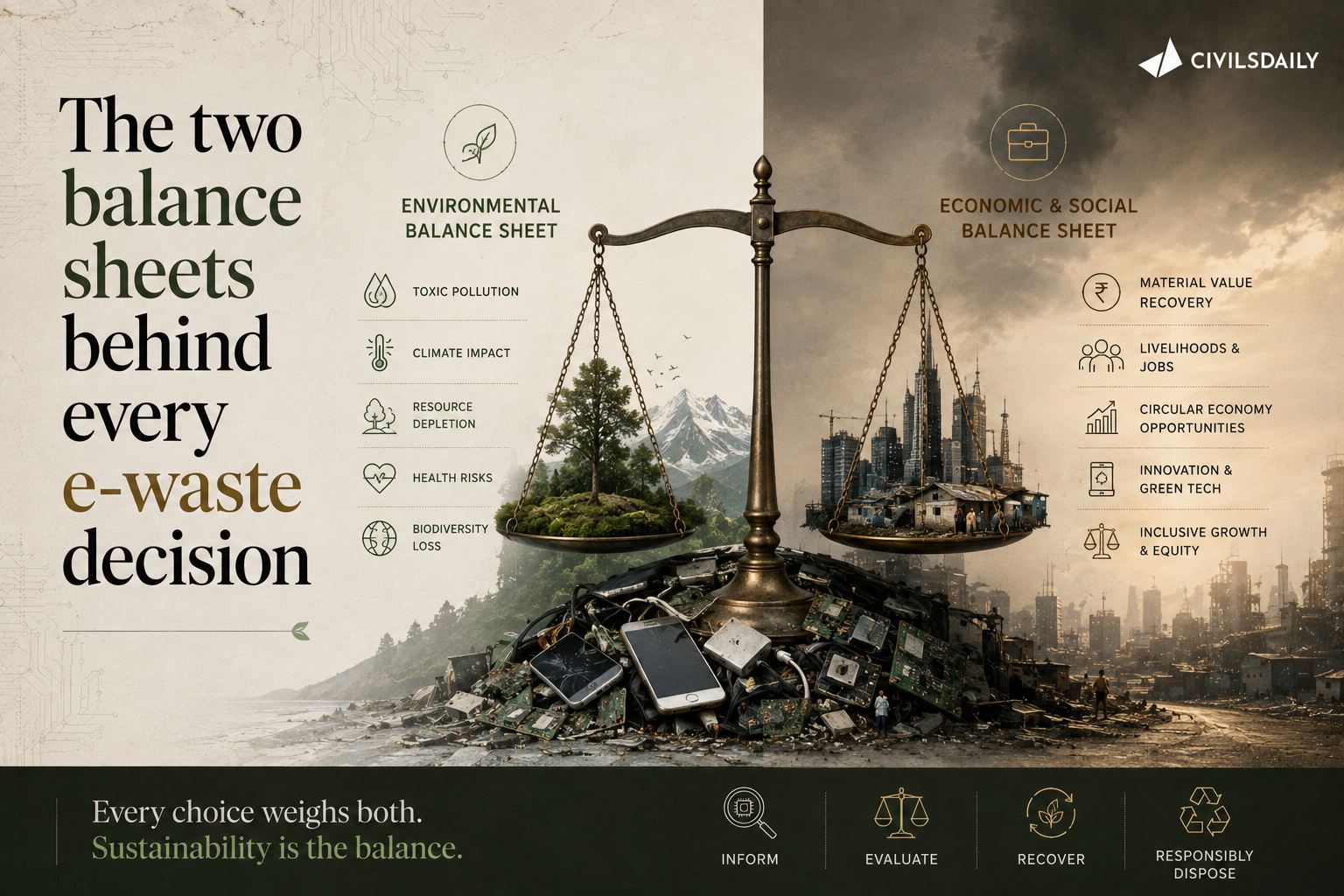
Governments and companies replace thousands of computers, servers, networking devices and storage systems every few years, and this discarded equipment holds copper, aluminium, gold, silver, palladium and critical minerals. Advanced recycling of such equipment has still not become the default choice in India. The reason is that procurement in both the public and private sectors rewards the lowest visible cost at the point of disposal. Every disposal decision creates two balance sheets, one financial and closed with the transaction, the other strategic and open long after it. The lowest-price principle that secures transparency and fiscal discipline in public procurement now sits in tension with the lifetime cost of decisions in electronics, batteries and renewable energy.
What is urban mining?
- Definition: Urban mining is the recovery of valuable materials from products that have already served their purpose, in place of extracting fresh ore from the earth.
- The ore body: Discarded IT equipment is among the largest untapped sources of strategic raw materials as economies digitise, and it is hazardous waste when poorly handled.
- What safe recovery needs: Sophisticated technology, secure data destruction, environmentally compliant processing and traceable supply chains, with collection and segregation adding to the cost.
Why has advanced recycling not become the default choice in India?
- Procurement rewards the lowest visible cost: Public and private buyers maximise resale value and minimise processing cost when they dispose of equipment.
- Strategic value stays off the invoice: Recovery of critical minerals, secure data destruction, environmental benefit and domestic industrial capability rarely appear in the price that decides the contract.
- The gains accrue to others: Less virgin mining, stronger domestic supplies of critical materials, lower import dependence and responsible handling of hazardous components are benefits the disposing organisation does not book.
What are the two balance sheets every disposal decision creates?
- The first, financial and immediate: Purchase price, resale value and savings achieved, all measurable, auditable and reflected in annual budgets.
- The second, strategic and open ended: It stays open long after the transaction and records resource security, environmental sustainability, industrial capability, supply-chain resilience, public health and national competitiveness.
- Good governance manages both: Some investments look expensive at first and later transform economies. Eg. Fifteen years ago solar power struggled to compete with conventional electricity on cost and governments that invested early were criticised for paying too much. Scale and learning have since made solar one of the world’s cheapest sources of electricity, and countries that built manufacturing capacity early hold advantages a cost comparison could not have predicted.
How do the costs left off the invoice return later?
- Recovery priced against disposal: Investment in urban mining infrastructure looks expensive when judged only against the cost of disposing of a computer. The calculation changes when recovered materials, avoided imports, environmental safeguards, data security and future industrial capability are counted together.
- Pollution becomes health-care expenditure: The public health cost of unsafe processing lands on the exchequer years after the disposal saving was booked.
- Resource depletion becomes import dependence: Metals not recovered at home are bought abroad, raising manufacturing costs.
- Weak domestic capability becomes strategic vulnerability: An economy without recovery capacity depends on others for the materials its industry runs on.
- Environmental costs turn economic: Governments spend more on remediation, businesses face higher compliance costs and citizens pay through taxes and lost productivity. The costs are delayed or redistributed and rarely avoided.
What should an organisation ask before selecting a recycler?
- Secure data destruction: Whether sensitive data on the equipment is securely destroyed before any material moves.
- Refurbishment before recycling: Whether working equipment is refurbished for reuse before it is broken down for materials.
- Efficient and transparent mineral recovery: Whether critical minerals are recovered efficiently and the recovery is traceable.
- The cost of skipping the questions: A marginal gain today becomes tomorrow’s cybersecurity risk, import dependence, reputational damage and permanent loss of strategic resources.
Can the lowest-price principle survive in sectors where acquisition cost is not lifetime cost?
- What the principle protects: Governments have relied on the lowest-price rule to ensure transparency and fiscal discipline in public spending.
- Where it fails: Renewable energy systems, batteries, electronics and advanced manufacturing are sectors where the lowest acquisition cost is rarely the lowest lifetime cost.
- The alternative many countries have adopted: Life-cycle costing (pricing an option across purchase, operation, disposal and recovery rather than at purchase alone) and value-based procurement ask which option delivers the greatest long-term public value. Procurement then becomes a tool of industrial policy that shapes which technologies scale and which capabilities are built.
- The same logic in compliance markets: Judging Extended Producer Responsibility (EPR, the obligation on a producer to finance the collection and recycling of the products it sells) compliance on the cheapest available certificate rewards the lowest-cost provider over the highest-quality outcome. Rewarding traceability, recovery efficiency and technological capability would instead draw investment into advanced recycling and strengthen India’s domestic supply of critical minerals.
Challenges to urban mining of e-waste in India
- Fake certificates break traceability: An EPR certificate market cannot reward quality when the certificates themselves are unverified. Eg. The Central Pollution Control Board (CPCB) found over 600,000 fake recycling certificates in 2023 across Gujarat, Maharashtra, Karnataka.
The Fix: Digitise certificate tracking against audited mass balance at each registered recycler, with cancellation of registration for a fake certificate. - A floor price too low to sustain formal recycling: EPR pricing set below the cost of compliant recovery pushes material to informal and fraudulent channels. Eg. In April 2025 Daikin, Hitachi and Samsung sued the government opposing the mandated minimum recycler price.
The Fix: Index the floor price to the audited cost of compliant recovery and revise it annually through a published formula. - Inefficient recovery loses the minerals the policy exists to secure: Crude recycling wastes lithium, cobalt, nickel, copper, gold and silver. Eg. Improper battery handling alone could cost India over USD 1 billion in foreign exchange by 2030.
The Fix: Fund research in advanced shredding, bioleaching and non-thermal recovery and tie EPR credit to recovery efficiency rather than to tonnage collected. - No domestic refining of precious metals: Indian recyclers dismantle equipment and export the printed circuit boards, so the highest-value step happens abroad. Eg. Circuit boards from Indian dismantlers are shipped to integrated smelters in Belgium, Japan and South Korea for gold and palladium refining.
The Fix: Mandate a minimum domestic refining share within EPR targets and treat integrated refining as eligible infrastructure under the critical mineral recycling incentive.
Conclusion
India’s discarded IT equipment will become either a strategic reserve or an environmental liability, and the deciding instrument is the procurement rule rather than the recycling technology. The reform that follows is to score public disposal tenders on lifetime value. That means amending the General Financial Rules, 2017, the rules for central procurement, so that a tender can weigh quality of recovery against the immediate price. The unresolved question is who pays: the buyer who funds advanced recycling is not the one who gains from resource security, and no mechanism yet closes that gap.
E-Waste Management in India
- Scale: As per the CPCB, India generated 14,14,645 metric tonnes (about 1.41 million tonnes) of e-waste in 2025-26 till March 2026, of which 9,79,080 metric tonnes (about 0.98 million tonnes) was recycled.
- Global standing and growth: India is the third largest generator behind China and the United States. Volumes surged over 150 percent in six years from 0.71 million tonnes in 2017-18 and are projected to nearly double by 2030.
- Formal capacity: 386 registered recyclers across 19 States and Union Territories offer a capacity of about 34.66 lakh metric tonnes per annum.
- Concentration: Just 65 cities generate over 60 percent of total e-waste, and 10 States account for around 70 percent.
Laws and Rules Governing E-Waste Management
- Environment (Protection) Act, 1986: The parent statute under which every set of e-waste rules is notified.
- E-Waste (Management) Rules, 2016: Introduced the Producer Responsibility Organisation (PRO) concept.
- E-Waste (Management) Rules, 2022: Make EPR the core engine, mandate registration of all producers, refurbishers and recyclers on the CPCB portal, and expand coverage from 21 to 106 electrical and electronic equipment items.
- E-Waste (Management) Second Amendment Rules, 2023: Added provisions for safe, sustainable refrigerant management in refrigeration and air-conditioning manufacturing.
- E-Waste (Management) Amendment Rules, 2024: Enabled CPCB supervised platforms for trading EPR certificates, priced between 30 percent and 100 percent of the environmental compensation for non-compliance.
- Hazardous and Other Wastes (Management and Transboundary Movement) Amendment Rules, 2025: Introduced an EPR framework for non-ferrous metal scrap, with targets rising from 10 percent in 2026-27 to 75 percent in 2032-33.
- Basel Convention, 1989: India is a signatory to this treaty limiting the transboundary movement of hazardous waste, including e-waste.
Challenges in E-Waste Management
- Informal-sector dominance: Over 50 percent of e-waste is handled informally through open-air burning and acid leaching, exposing workers and residents to respiratory illness, neurological damage and DNA damage. Eg. Acid leaching of circuit boards in Moradabad releases toxic slurry into the Ramganga and local groundwater.
The Fix: Train waste-pickers as certified green collar technicians with protective gear, certification and links to healthcare, insurance and pensions. - Illegal imports: Developed nations export e-waste to India under cover of used goods. Eg. 29 illegal-import instances were identified during 2019-22 across Tamil Nadu, Maharashtra, Gujarat, West Bengal and Uttar Pradesh.
The Fix: Pre-shipment inspection of used electronics consignments at ports under the Basel Convention notification procedure. - Low awareness in the trade itself: The people who handle discarded electronics first do not know the rules. Eg. A 2021 Delhi study found 70 percent of repair workers and 79 percent of scrap dealers unaware of e-waste rules.
The Fix: Run registration and awareness campaigns through resident welfare associations and self-help groups linked to registered collection points. - Uneven infrastructure: Recycling capacity and expertise are concentrated in a few States. Eg. Telangana has built formal capacity, and Chandigarh lacks formal facilities.
The Fix: Set up decentralised recycling hubs in every State with a collection target tied to the State’s generation share.