💥Join UPSC 2027,2028 Mentorship (July Batch) + XFactor Notes & Microthemes PDF

Type: PIB

  • India’s Space Odyssey: Prelims Quick Revision

    Why in News?

    The Government highlighted India’s achievements under Space Vision 2047, focusing on self-reliance, commercialization, and human spaceflight.

    Major Missions

    • Chandrayaan-3 (2023): First soft landing near Moon’s south pole; confirmed sulphur.
    • Chandrayaan-4 (2027): Lunar sample return mission.
    • LUPEX (2027-28): ISRO-JAXA mission to explore lunar polar ice.
    • Mangalyaan: First country to reach Mars on maiden attempt.
    • Aditya-L1: India’s first solar observatory at Sun-Earth L1.
    • Venus Orbiter Mission: Planned for 2028.
    • Gaganyaan: India’s first human spaceflight programme.
    • Bharatiya Antariksh Station (BAS): First module by 2028.

    Space Technology

    • SpaDeX (2025): India became 4th nation to achieve autonomous space docking.
    • NavIC: Indigenous navigation system covering India and 1,500 km beyond.
    • VIKRAM3201: First indigenous 32-bit space microprocessor.
    • RLV-TD: Developing reusable launch vehicle technology.

    Space Economy

    • Space startups: 1 (2014) → 400+ (2026).
    • Space economy: $8 billion, targeted to reach $40-45 billion by 2030.
    • Major reforms: IN-SPACe, NSIL, Indian Space Policy 2023, Liberalised FDI.

    Launch Infrastructure

    • Operational launch vehicles: PSLV, GSLV, LVM3.
    • NGLV under development (30-ton LEO capacity).
    • Second spaceport: Kulasekarapattinam, Tamil Nadu.
    • Third launch pad approved at Sriharikota.

    International Cooperation

    • NISAR: ISRO-NASA
    • TRISHNA: ISRO-CNES
    • LUPEX: ISRO-JAXA
    • Human spaceflight cooperation with ESA and Russia.

    Space Applications

    • Disaster management, Telemedicine, PM e-VIDYA, India-WRIS, Potential Fishing Zone advisories, and Satellite Aided Search and Rescue (SASAR).
  • Fast X-ray Transients (FXTs)

    Why in the news?

    Astronomers from the Indian Institute of Astrophysics have traced the likely origin of a rare Fast X-ray Transient (FXT) event, EP241107a, detected by the Einstein Probe in November 2024.

    Key Findings

    • FXTs are energetic, non-repeating flashes of X-rays lasting from a few minutes to several hours.
    • They are a recently discovered class of transient cosmic events whose origin has remained uncertain.
    • Researchers identified a radio counterpart of FXT EP241107a using the Karl G. Jansky Very Large Array.
    • Follow-up observations were conducted using:
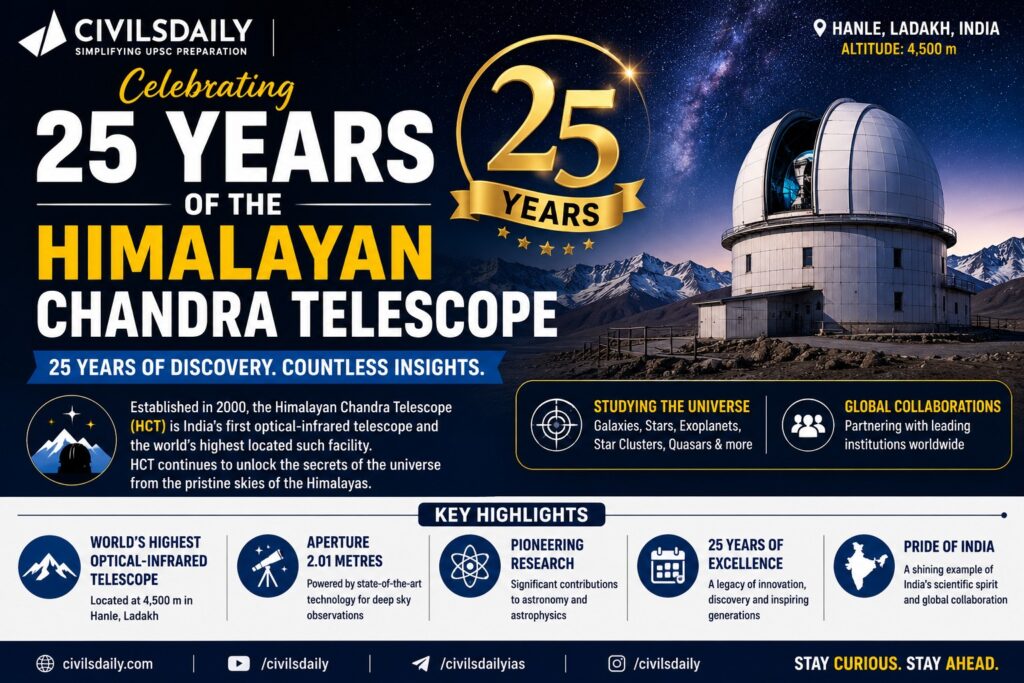
      • Himalayan Chandra Telescope
      • GROWTH India Telescope
      • Upgraded Giant Metrewave Radio Telescope

    Likely Origin

    • The event was probably caused by: Collapse of a massive star leading to a supernova and gamma-ray burst (GRB), or Merger of two neutron stars.
    • Researchers concluded that EP241107a is most likely an “orphan afterglow”:
      • A gamma-ray-burst-like explosion whose gamma rays were not directly detected.
      • Represents a lower-energy member of the GRB population.

    Fast X-ray Transients (FXTs)

    • Sudden flashes of low-energy X-rays.
    • Non-repeating and short-lived.
    • Fade rapidly after detection.
    • Associated with highly energetic cosmic explosions.

    Proposed Sources

    • Core-collapse supernovae.
    • Binary neutron star mergers.
    • Magnetars (highly magnetized neutron stars).
    • Tidal disruption events involving white dwarfs and black holes.
    • Gamma-ray bursts (GRBs).

    Gamma-Ray Bursts (GRBs)

    • Most energetic explosions known in the Universe.
    • Emit intense gamma radiation for a few milliseconds to several minutes.
    • Associated with the collapse of massive stars (Long GRBs) and Neutron star mergers (Short GRBs).
    • Followed by multi-wavelength “afterglows” in X-ray, optical, and radio bands.

    Neutron Star

    • Extremely dense remnant of a massive star after a supernova.
    • Mass ≈ 1.4-2 solar masses compressed into a sphere about 20 km across.
    • Composed mainly of neutrons.

    [2023] Consider the following pairs: Objects in space : Description
    1. Cepheids : Giant clouds of dust and gas in space
    2. Nebulae : Stars which brighten and dim periodically
    3. Pulsars : Neutron stars that are formed when massive stars run out of fuel and collapse
    How many of the above pairs are correctly matched ?

    [A] Only one

    [B] Only two

    [C] All three

    [D] None

  • India’s First Commercial-Scale Coal-to-Ammonium Nitrate Project

    Why in the news?

    The Prime Minister will lay the foundation stone of India’s first commercial-scale Coal-to-Ammonium Nitrate Project at Lakhanpur, Jharsuguda district, Odisha. The project, worth ₹25,016 crore, is a major step towards energy security, import substitution, and industrial self-reliance.

    Coal Gasification

    • A process that converts coal into Synthesis Gas (Syngas), mainly consisting of carbon monoxide (CO) and hydrogen (H₂).
    • Syngas can be used to produce Methanol, Urea, Ammonia, Ammonium Nitrate, Synthetic Natural Gas (SNG), Other chemical feedstocks

    Lakhanpur Project

    • India’s first commercial-scale Coal-to-Ammonium Nitrate facility.
    • Developed by Bharat Coal Gasification and Chemicals Limited, a joint venture of Bharat Heavy Electricals Limited and Coal India Limited.
    • Located on about 350 acres under Mahanadi Coalfields Limited land.
    • Capacity: 2,000 tonnes/day of Ammonium Nitrate.
    • Uses indigenous coal gasification technology developed by BHEL.
    • Receives ₹1,350 crore support under the Coal Ministry’s incentive scheme.

    Significance

    • Reduces dependence on imported natural gas, ammonia, methanol, and chemicals.
    • Supports Aatmanirbhar Bharat and domestic manufacturing.
    • Enhances value addition to India’s vast coal reserves (>400 billion tonnes).
    • Expected to boost downstream chemical and fertilizer industries.

    [2025] Consider the following substances:
    I. Ethanol
    II. Nitroglycerine
    III. Urea
    Coal gasification technology can be used in the production of how many of them?

    [A] Only one

    [B] Only two

    [C] All the three

    [D] None

  • International Sickle Cell Day 2026

    Why in the news?

    The President of India, Droupadi Murmu, commemorated International Sickle Cell Day at Omkareshwar and highlighted the achievements of the National Sickle Cell Anaemia Elimination Mission (NSCAEM).

    National Sickle Cell Anaemia Elimination Mission (2023)

    • Launched to eliminate Sickle Cell Disease (SCD) as a public health problem by 2047.
    • Targets screening of 7 crore people (0-40 years age group) in affected tribal and high-prevalence areas.
    • One of the world’s largest genetic disease screening programmes.
    • So far: Around 2.5 lakh patients identified. Over 20 lakh carriers detected.

    Sickle Cell Disease (SCD)

    • A hereditary genetic blood disorder caused by mutation in the haemoglobin gene.
    • Red blood cells become sickle-shaped, reducing oxygen supply.
    • Leads to anaemia, pain episodes, infections, organ damage, and reduced life expectancy.
    • Inherited in an autosomal recessive pattern.

    High-Risk Areas in India

    • Predominantly affects tribal populations across Madhya Pradesh, Maharashtra, Chhattisgarh, Odisha, Gujarat, Jharkhand, and Rajasthan

    Madhya Pradesh Initiatives

    • Sickle Mitra Initiative: Trains volunteers, NCC cadets, and civil society members for awareness and patient support.
    • Swasth Nari, Sashakt Parivar Abhiyan (2025): Screened over 4 lakh women for SCD.

    [2023] Consider the following statements in the context of interventions being undertaken under Anaemia Mukt Bharat Strategy:
    1. It provides prophylactic calcium supplementation for pre-school children, adolescents and pregnant women.
    2. It runs a campaign for delayed cord clamping at the time of child- birth.
    3. It provides for periodic deworming to children and adolescents.
    4. It addresses non-nutritional causes of anaemia in endemic pockets with special focus on malaria, hemoglobinopathies and fluorosis.
    How many of the statements given above are correct?

    [A] Only one

    [B] Only two

    [C] Only three

    [D] All four

  • Advancing Electrolyte Engineering for Durable and Affordable Aqueous Batteries

    Why in the news?

    Scientists at the Institute of Nano Science and Technology (INST), Mohali, under the Department of Science and Technology (DST), have developed a novel electrolyte additive (BDIM) that significantly improves the performance and lifespan of Aqueous Zinc-Ion Batteries (AZIBs).

    Key Highlights

    • AZIBs are emerging as safer, cheaper, and more sustainable alternatives to lithium-ion batteries.
    • Major challenges:
      • Zinc dendrite formation
      • Hydrogen Evolution Reaction (HER)
      • Corrosion of zinc anode
      • Poor cycling stability
    • Researchers developed BDIM (1,3-bis(1,3-dicarboxypropyl)-1H-imidazole-3-ium chloride) as an electrolyte additive.
    • BDIM selectively adsorbs on the zinc surface and occupies the Inner Helmholtz Plane (IHP).
    • It displaces water molecules, thereby:
      • Suppressing hydrogen evolution
      • Reducing corrosion
      • Preventing dendrite growth
      • Enhancing battery life and safety
    • Researchers used: Ultramicroelectrode (UME) and Fast-Scan Cyclic Voltammetry (FSCV)
      to study zinc deposition mechanisms.

    Significance

    • Extends battery lifespan without costly material redesign.
    • Improves safety and reliability of rechargeable batteries.
    • Supports large-scale renewable energy and grid-storage applications.
    • Can reduce maintenance costs of energy-storage infrastructure.

    Prelims Facts

    • AZIB Electrolyte: Water-based, making it non-flammable and safer than lithium-ion batteries.
    • Inner Helmholtz Plane (IHP): Region near the electrode surface where electrochemical reactions occur.
    • Hydrogen Evolution Reaction (HER): Undesirable side reaction that reduces battery efficiency.
  • Qadian-Beas Railway Line Project Revived

    Why in the news?

    The Government of India has revived the Qadian-Beas New Railway Line Project in Punjab after nearly a century. The project was originally approved during 1928-29 by the North-Western Railway but remained incomplete.

    Key Highlights

    • Length: 39.68 km broad-gauge railway line.
    • Cost: Approximately ₹1,400 crore.
    • Implementing Agency: Northern Railway.
    • Route: Qadian (Gurdaspur) – Dhapai – Ghuman – Butala – Sathiala – Beas (Amritsar).
    • Revived under the Socially Desirable Rail Connectivity Programme.

    Infrastructure Features

    • 2 crossing stations (Ghuman and Butala).
    • 11 major bridges and 121 minor bridges.
    • 54 Road Under Bridges (RUBs).
    • Modern signalling and telecommunication systems.
    • Deployment of Kavach, India’s indigenous train collision avoidance system.

    Significance

    • Connectivity: Brings several areas of Punjab’s Majha region onto the railway network. Improves mobility and accessibility for residents.
    • Strategic Importance: Provides an alternative corridor to the Amritsar-Pathankot railway section during emergencies. Enhances resilience of railway operations in northern India.
    • Economic Benefits
      • Better market access for farmers.
      • Faster transportation of agricultural produce.
      • Boost to trade, commerce, and small-scale industries.
      • Employment generation during construction and operation.
    • Tourism: Improves access to major religious destinations including Qadian, Dera Baba Jaimal Singh, Sri Darbar Sahib, Dera Baba Nanak, and Gurdwara Achal Sahib
  • Indigenous Air Cushion Vehicle (ACV) Inducted into Indian Coast Guard

    Why in News?

    The Indian Coast Guard (ICG) inducted the first of six indigenously built Air Cushion Vehicles (ACVs), or hovercraft, at Goa on 18 June 2026. The vessels are being constructed by Chowgule & Company Private Limited under a Ministry of Defence contract.

    Key Highlights

    • First ACV inducted into ICG service in Goa.
    • Part of a contract for six indigenous hovercraft.
    • Contract signed between the Ministry of Defence and Chowgule & Company Pvt. Ltd. on 24 October 2024.
    • Supports the vision of Aatmanirbhar Bharat.
    • Enhances India’s indigenous maritime manufacturing capability.

    What is an Air Cushion Vehicle (ACV)?

    • A hovercraft that travels on a cushion of pressurised air.
    • Can operate over Water, Mudflats, Marshes, Sandbanks, Shallow and coastal areas
    • Combines features of both marine vessels and aircraft.
  • 10th India-Thailand Defence Dialogue (2026)

    Why in the news?

    The 10th India-Thailand Defence Dialogue was held in Bangkok on 16 June 2026 to review bilateral defence cooperation and discuss regional and global security issues.

    Key Highlights

    • Reviewed the full spectrum of India-Thailand defence cooperation.
    • Discussed the evolving security environment in the Indo-Pacific.
    • Reaffirmed commitment to peace, stability, and prosperity in the region.
    • Reviewed progress in:
      • Military-to-military engagements.
      • Capacity-building initiatives.
      • Training exchanges.
      • Maritime cooperation.

    Defence Industry Cooperation

    • Agreed to deepen collaboration in:
      • Defence manufacturing.
      • Research and development (R&D).
      • Innovation.
      • Capability development.
    • Aim: Promote mutually beneficial partnerships between the defence ecosystems of both countries.

    Regional & Multilateral Cooperation

    • Discussed cooperation under Association of Southeast Asian Nations-led mechanisms.
    • Reaffirmed commitment to addressing shared security challenges through dialogue and collaboration.

    India-Thailand Relations

    • Bilateral ties elevated to a Strategic Partnership in 2025.
    • Thailand is an important partner in India’s:
      • Act East Policy.
      • Indo-Pacific Oceans Initiative (IPOI).
      • Maritime and regional connectivity efforts.

    [2023] With reference to India’s projects on connectivity, consider the following statements::
    1. East-West Corridor under Golden Quadrilateral Project connects Dibrugarh and Surat.
    2. Trilateral Highway connects Moreh in Manipur and Chiang Mai in Thailand via Myanmar.
    3. Bangladesh- China- India- Myanmar Economic Corridor connects Varanasi in Uttar Pradesh with Kunming in China.
    How many of the above statements are correct?

    [A] Only one

    [B] Only two

    [C] All three

    [D] None

  • World Day to Combat Desertification and Drought 2026

    Why in the news?

    The World Day to Combat Desertification and Drought (17 June) was celebrated across 813 project areas under the WDC–PMKSY 2.0 (Watershed Development Component of Pradhan Mantri Krishi Sinchayee Yojana 2.0).

    WDC–PMKSY 2.0

    • Implemented by the Department of Land Resources (DoLR) under the Ministry of Rural Development (MoRD).
    • Focuses on:
      • Soil and water conservation.
      • Restoration of degraded lands.
      • Enhancing resilience of rainfed agriculture.
      • Sustainable watershed development.

    Major Interventions

    • Check dams, Percolation tanks, Farm ponds, Water harvesting and groundwater recharge structures

    Key Outcomes

    • Improved water availability in rainfed areas.
    • Enables second and third crop cultivation.
    • Enhances farmers’ income and livelihood security.
    • Strengthens drought resilience and climate adaptation.

    Activities Conducted

    • Bhoomi Poojan of 1,444 new watershed development works.
    • Lokarpan (Inauguration) of 8,341 completed watershed assets.
    • Plantation of 51,299 saplings under “Ek Ped Maa Ke Naam” campaign.
    • Public pledge: “For a Developed India, Let Us Build a Drought-Free India.”

    Significance

    • Promotes community-led land and water conservation.
    • Supports land restoration, water security, and climate resilience.
    • Contributes to sustainable rural development and combating desertification.

    [2016] What is/are the importance/importances of the ‘United Nations Convention to Combat Desertification’?

    1. It aims to promote effective action through innovative national programmes and supportive international partnerships.

    2. It has a special focus on South Asia and North Africa regions, and its Secretariat facilitates allocation of major portions of financial resources to these regions.

    3. It is committed to a bottom-up approach, encouraging participation of local people in combating desertification.

    A 1 only

    B 2 and 3 only

    C 1 and 3 only

    D 1, 2 and 3

  • Green Hydrogen Certification Portal of India (GHCI) & National Green Hydrogen Mission (NGHM)

    Why in the news?

    The Ministry of New and Renewable Energy (MNRE) launched the Green Hydrogen Certification Portal of India (GHCI) to ensure transparent certification and regulatory compliance for green hydrogen production.

    GHCI

    • Developed by MNRE (Ministry of New and Renewable Energy).
    • Certifies green hydrogen under the Green Hydrogen Certification Scheme of India (GHCI Scheme).
    • Enhances transparency, traceability, and market credibility.

    National Green Hydrogen Mission (NGHM)

    • Launched in 2023.
    • Outlay: ₹19,744 crore.

    Targets by 2030

    • 5 Million Metric Tonnes (MMT) of green hydrogen production.
    • 125 Gigawatt (GW) dedicated renewable energy capacity.
    • ₹8 lakh crore investment.
    • 6 lakh jobs.
    • Reduction of 50 million tonnes of carbon dioxide (CO₂) emissions annually.

    Key Progress

    • 6 States have dedicated Green Hydrogen Policies; 7 States have integrated hydrogen into existing policies.
    • Incentives awarded to 15 companies for 3,000 MW (Megawatt) per year electrolyser manufacturing capacity.
    • Under SIGHT (Strategic Interventions for Green Hydrogen Transition), incentives approved for 8.62 lakh Metric Tonnes Per Annum (MTPA) of green hydrogen production.
    • Contracts awarded for 30,000 MTPA green hydrogen supply to refineries.
    • Agreements signed for 6.7 lakh MTPA of Green Ammonia supply to 11 fertilizer plants.
    • ₹84 crore sanctioned for hydrogen injection pilot projects in the steel sector.
    • ₹208 crore allocated for 37 hydrogen-powered vehicles and 9 refuelling stations.
    • ₹113 crore allocated for Research and Development (R&D) projects.
    • ₹100 crore startup fund; first 9 startups approved with ₹22 crore support.

    Green Hydrogen

    • Hydrogen produced through electrolysis using renewable energy.
    • A zero-carbon fuel for sectors such as steel, fertilizers, refineries, shipping, and heavy transport.

    [2023] With reference to green hydrogen, consider the following statements:
    1. It can be used directly as a fuel for internal combustion.
    2. It can be blended with natural gas and used as fuel for heat or power generation.
    3. It can be used in the hydrogen fuel cell to run vehicles.
    How many of the above statements are correct?

    [A] Only one

    [B] Only two

    [C] All three

    [D] None